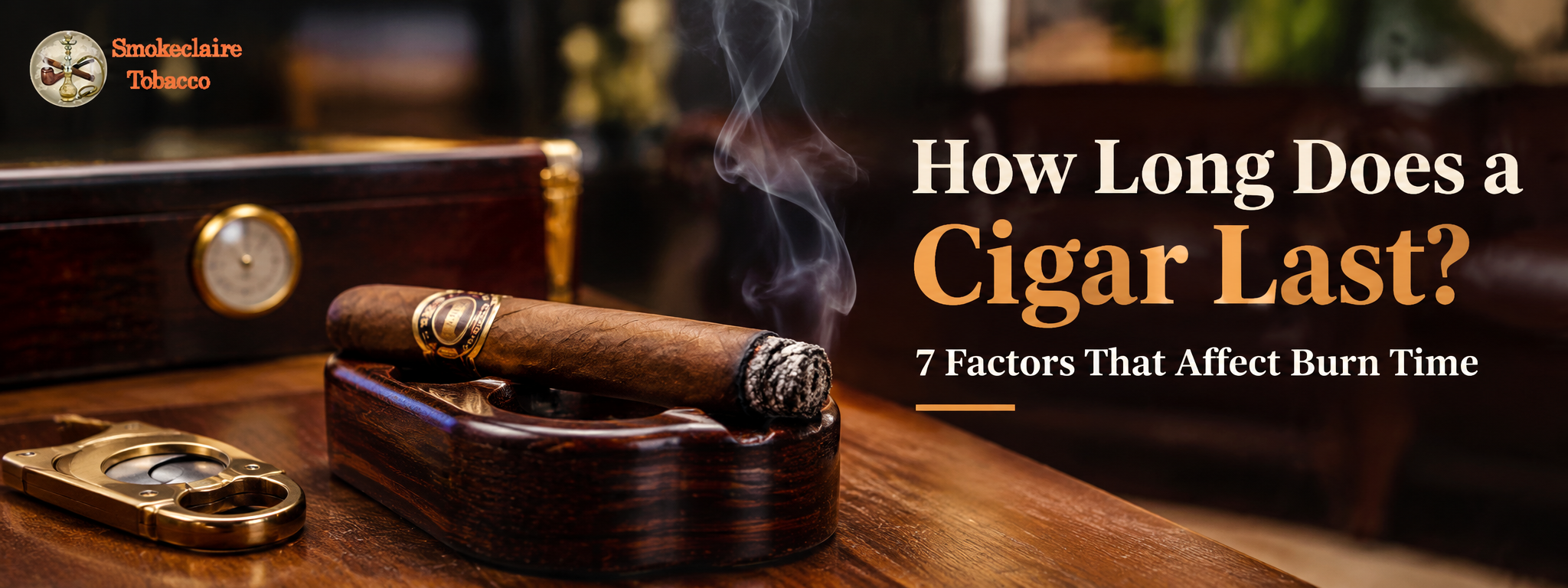
How Long Does a Cigar Last? 7 Factors That Affect Burn Time
A cigar can take anywhere from around 20–30 minutes to more than two hours to smoke, depending on its size, construction, tobacco blend and smoking pace. A smaller cigar usually takes less time than a large, thick one, but size alone does not determine how long it will burn.
If you've wondered how long does a cigar last when smoking, the most useful starting point is the cigar's dimensions. Its length and ring gauge influence how much tobacco it contains, while construction, moisture and smoking pace affect how evenly it burns.
Understanding these factors also helps explain why two cigars of similar size can have different burn times. Here's what influences cigar burn time, what cigar ash can tell you and how to estimate the time a cigar may require.
How Long Does a Cigar Last When Smoking?
The time required to smoke a cigar varies by format and individual smoking habits. These estimates provide a general guide rather than a guaranteed duration.
|
Cigar type |
Approximate smoking time |
|
Small cigarillo |
10–20 minutes |
|
Small cigar |
20–30 minutes |
|
Short, slim cigar |
20–40 minutes |
|
Medium-sized cigar |
30–60 minutes |
|
Large cigar |
60–90 minutes |
|
Extra-large cigar |
90 minutes to 2 hours or longer |
Actual burn times can fall outside these ranges. A thick cigar smoked slowly may last longer than a slimmer cigar, while an unevenly constructed cigar may burn inconsistently regardless of its size.
When considering how long does a cigar last once lit, remember that the clock is only part of the answer. The cigar's construction, moisture level and the intervals between puffs all influence how quickly it burns.
7 Factors That Affect Cigar Burn Time
1. Cigar Length
Length is one of the most straightforward factors affecting smoking time. A longer cigar generally contains more tobacco than a shorter cigar of a similar diameter, giving it more material to burn through.
For example, a short cigar may suit someone with limited time, while a longer format can require a substantially longer smoking session. However, length should not be considered in isolation. Two cigars with the same length may have different diameters, tobacco blends and construction.
2. Cigar Ring Gauge
Cigar ring gauge measures a cigar's diameter in units of 1/64 of an inch. A cigar with a ring gauge of 50, for example, measures 50/64 of an inch in diameter.
A higher ring gauge generally means a thicker cigar. Thick cigars contain more tobacco across their diameter and may take longer to smoke than slimmer cigars of similar length.
Diameter can also affect how a cigar burns and how its blend is perceived. A thicker cigar may contain a different combination of filler tobaccos, which can influence its character and burn behavior.
Ring gauge is therefore useful when comparing similarly sized cigars, but it does not provide an exact smoking-time calculation.
3. Construction and Draw
A cigar's construction affects how air moves through the tobacco and how consistently it burns.
A well-constructed cigar generally has an even shape and a draw that allows air to pass through without excessive resistance. Construction problems can create an uneven burn, cause one side to burn faster than another or make the cigar difficult to keep lit.
Tightly packed tobacco can restrict airflow, while loose construction may allow the cigar to burn more quickly than expected. The wrapper, binder and filler also work together to influence the cigar's overall burn.
Cigar ash can provide a limited visual clue about construction. Ash that holds together briefly and develops relatively evenly may indicate a consistent burn, although ash appearance alone cannot prove that a cigar is well made. Ash color and strength vary with tobacco, manufacturing and other conditions.
4. Tobacco Blend
The tobacco used in a cigar influences its flavor, aroma, body and combustion characteristics.
A cigar may contain different tobacco varieties in its filler, binder and wrapper. These components can vary in leaf thickness, oil content and other physical properties, affecting how the cigar burns.
The blend can also affect how a cigar feels throughout the smoking experience. However, strength and burn time are not interchangeable: a cigar described as full-bodied does not automatically burn longer than a mild cigar of the same dimensions.
5. Tobacco Moisture and Storage Conditions
Humidity influences the condition of cigar tobacco. Cigars that are too dry may burn more quickly and unevenly, while excess moisture can make them difficult to keep lit and affect the draw.
Proper storage helps maintain a cigar's condition before it is smoked. A humidor is commonly used to regulate humidity, although the appropriate conditions depend on the cigar and storage environment.
Changes in temperature and humidity can affect tobacco over time, so a cigar's storage history may help explain why its burn differs from expectations.
Moisture does not provide a simple formula for burn time. Its effects depend on the cigar's construction, the degree of dryness or excess moisture and the conditions in which it is smoked.
6. Smoking Pace
Smoking pace is one of the factors a smoker can most directly influence.
Frequent puffs keep the burning end active and can make the cigar burn faster. Longer gaps between puffs allow it to cool and may cause it to go out, particularly if the cigar is already burning unevenly.
This helps explain why the same cigar can last different amounts of time for different people. Someone who takes frequent puffs may finish sooner than someone who leaves longer intervals between them.
Smoking pace can also affect temperature and flavor. A cigar that becomes excessively hot may taste harsher or less balanced, so burn time should not be treated as a target to extend or shorten at the expense of the smoking experience.
7. Relighting and Interruptions
Interruptions can change the total time required to finish a cigar. A cigar that goes out may need to be relit and the time spent away from it adds to the overall session.
If a cigar is left unattended for too long, it may become difficult to relight or may develop an uneven burn. The effect depends on how long it has been out and its condition at that point.
This distinction matters when asking how long does a cigar last once lit. The total elapsed time can be considerably longer than the time spent actively smoking, especially when the session includes breaks.
How Long Does a Cuban Cigar Last When Smoking?
The question how long does a Cuban cigar last when smoking is often associated with the cigar's origin, but country of origin alone does not determine its burn time.
Cuban cigars come in different lengths, ring gauges, shapes and blends. A smaller Cuban cigar may take around 20–40 minutes, while a larger format may require an hour or longer. These are broad estimates, not guarantees for every cigar.
Construction and storage also matter. Two cigars from the same country can burn differently if they have different dimensions, tobacco blends or moisture levels.
What Does Cigar Ash Tell You About Burn Time?
Cigar ash is the material left behind as tobacco burns. Its appearance can vary in color, texture and how well it holds together.
Some cigars develop firm ash that remains attached for a while, while others produce ash that breaks away more readily. These differences can reflect tobacco composition, construction and combustion conditions.
However, cigar ash is not a reliable clock. Long ash does not necessarily mean a cigar will burn slowly and short ash does not automatically indicate a fast burn. The length of the ash is affected by how the tobacco holds together, not simply by how much smoking time remains.
The more useful signs to observe are whether the cigar is burning evenly and whether the burn line is consistent. These observations provide information about combustion, though they still cannot predict the exact time left.
How Can You Estimate a Cigar's Burn Time Before Smoking?
You can make a reasonable estimate by considering several characteristics together.
- Length: Longer cigars generally contain more tobacco to burn.
- Ring gauge: A thicker cigar may take longer than a slimmer cigar of similar length.
- Construction: Uneven packing and restricted airflow can affect the burn.
- Storage: Excessive dryness or moisture may change combustion.
- Smoking pace: Frequent puffs and long pauses can produce different total times.
If the manufacturer or retailer provides an estimated smoking time, use it as a starting point rather than a fixed promise. Your experience may differ because of the conditions in which the cigar is smoked.
Where to Find Cigars Near You
People searching for the best cigar shop near me may want more than a nearby address. Product variety, cigar information, storage practices and staff knowledge can all be relevant when choosing a retailer.
Before choosing a cigar, its dimensions, ring gauge, construction and expected smoking time can help you understand whether the format suits your preferences.
The most useful comparison starts with the cigar itself: its size, blend and construction are more meaningful indicators of burn time than origin or price alone.
Final Thoughts
So, how long does a cigar last when smoking? A small cigar may take around 20–30 minutes, a medium-sized cigar often takes 30–60 minutes and a larger format can take 90 minutes or more. The actual duration varies with the cigar and the way it burns.
Length and cigar ring gauge provide a starting estimate, while construction, tobacco blend, moisture, smoking pace and interruptions help explain variations in cigar burn time. Cigar ash can reveal something about the burn's consistency, but it cannot reliably tell you how much time remains.
The same principles apply when estimating how long does a cigar last once lit or comparing how long does a Cuban cigar last when smoking. Dimensions and construction provide more useful guidance than origin alone.
For customers in Eau Claire, SmokeClaire is a local retail option to consider when searching for cigar and tobacco-related products.
FAQs
1. How long does an average cigar take to smoke?
A medium-sized cigar often takes around 30–60 minutes. Smaller cigars may take less time, while larger formats can last 90 minutes or longer. Construction and smoking pace affect the actual duration.
2. Does a thicker cigar burn longer?
A thicker cigar often contains more tobacco than a slimmer cigar of the same length, so it may take longer to smoke. Ring gauge alone does not determine the exact burn time.
3. What does cigar ash indicate?
Cigar ash can offer limited clues about burn consistency and how well the tobacco holds together. Its color or length does not reliably indicate cigar quality or the time remaining.
4. Does cigar storage affect burn time?
Yes. Tobacco that is excessively dry or moist may burn differently from tobacco maintained in suitable storage conditions. Proper storage helps preserve the cigar's condition but cannot guarantee a particular burn time.
5. Does a stronger cigar last longer?
Not necessarily. Strength describes the cigar's perceived intensity, while burn time is more closely related to dimensions, construction, tobacco characteristics and smoking pace.